
With the passing of the One Big Beautiful Bill Act (OBBBA), the Federal Reserve cutting interest rates, and inflation showing signs of moderating, tax planning remains as important as ever for taxpayers seeking to manage cash flows and reduce their tax liabilities over time.
As we approach the end of the year, now is the time for individuals, business owners, and family offices to review their 2025 and 2026 tax situations and identify opportunities to reduce, defer, or accelerate their tax obligations. The information contained in this guide is based on federal laws and policies in effect as of the publication date. This guide discusses tax planning for U.S. federal income taxes. Applicable state and foreign taxes should also be considered. Taxpayers should consult with a trusted advisor when making tax and financial decisions regarding any of the following items.
Individual Tax Planning Highlights
2025 Federal Income Tax Rate Brackets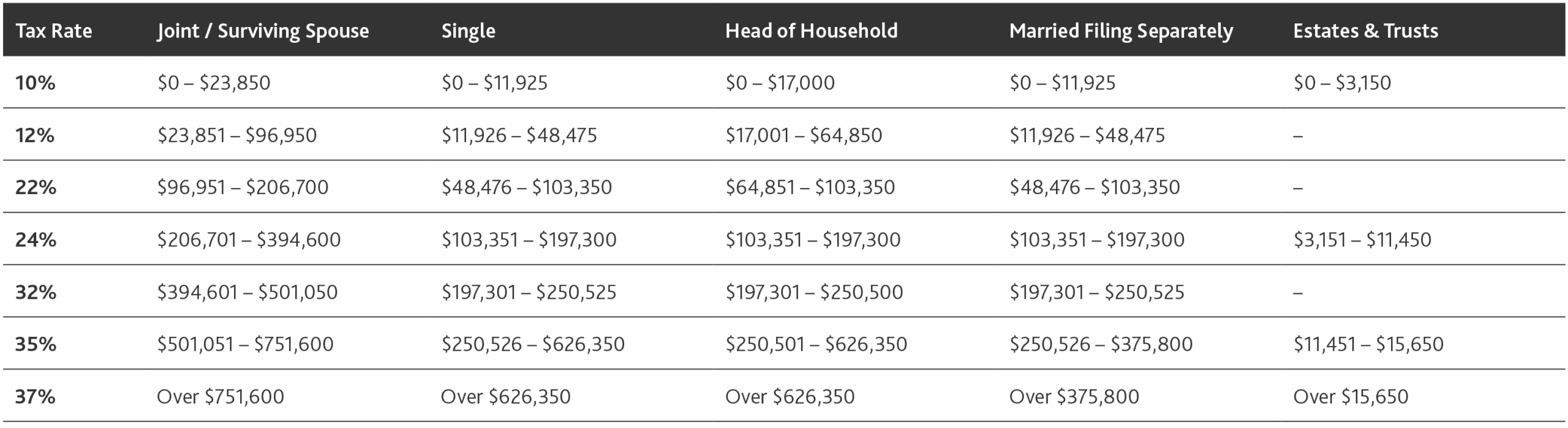
2026 Federal Income Tax Rate Brackets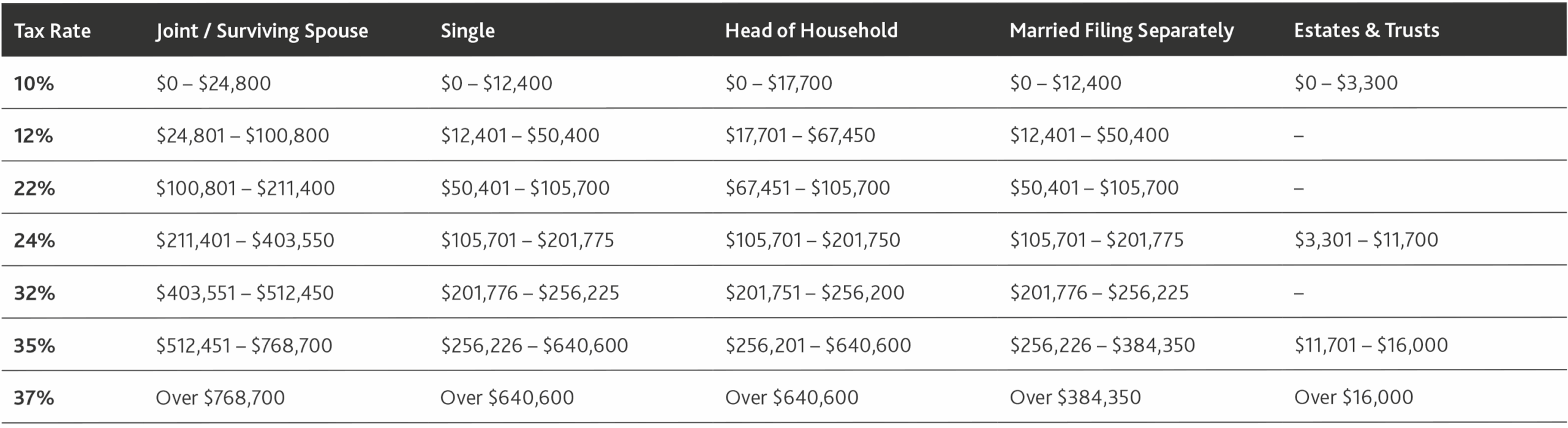
Timing of Income and Deductions
Taxpayers should consider whether they can reduce their tax bills by shifting income or deductions between 2025 and 2026. Ideally, income should be received in the year with the lower marginal tax rate, and deductible expenses should be paid in the year with the higher marginal tax rate. If the marginal tax rate is the same in both years, deferring income from 2025 to 2026 will produce a one-year tax deferral, and accelerating deductions from 2026 to 2025 will lower the 2025 income tax liability.
Actions to consider that may result in a reduction or deferral of taxes include:
- Delaying closing capital gain transactions until after year-end or structuring 2025 transactions as installment sales so that gain is deferred past 2025 (see also Long-Term Capital Gains).
- Triggering capital losses before the end of 2025 to offset 2025 capital gains.
- Delaying interest or dividend payments from closely held corporations to individual business-owner taxpayers.
- Deferring commission income by closing sales in early 2026 instead of late 2025.
- Accelerating deductions for expenses such as mortgage interest and charitable donations (including donations of appreciated property) to 2025 (subject to adjusted gross income (AGI) limitations).
- Evaluating whether non-business bad debts are worthless — and should be recognized as short-term capital losses – by the end of 2025.
- Shifting investments to municipal bonds or investments that do not pay dividends to reduce taxable income in future years.
Taxpayers who will be in a higher tax bracket in 2026 may want to consider ways to shift taxable income from 2026 to 2025, so it is taxed at a lower rate.
Current year actions to consider that could reduce 2026 taxes include:
- Accelerating capital gains to 2025 or deferring capital losses until 2026.
- Electing out of the installment sale method for 2025 installment sales.
- Accelerating deductions such as large contributions to 2025.
- Accelerating residential clean energy expenditures.
Long-term Capital Gains
The long-term capital gains rates for 2025 and 2026 are shown below. The tax brackets refer to the taxpayer’s taxable income. Capital gains also may be subject to the 3.8% net investment income tax.
2025 Long-Term Capital Gains Rate Brackets

2026 Long-Term Capital Gains Rate Brackets
Long-term capital gains (and qualified dividends) are subject to a lower tax rate than other types of income. Investors should consider the following when planning for capital gains:
- Holding capital assets for more than a year (more than three years for assets attributable to carried interests) so that the gain upon disposition qualifies for the lower long-term capital gains rate.
- Adopting long-term deferral strategies for capital gains, such as reinvesting capital gains in designated qualified opportunity zones.
- Investing in, and holding, “qualified small business stock” for at least three years.
- Donating appreciated property to a qualified charity to avoid long-term capital gains tax (also see Charitable Contributions below).
Net Investment Income Tax
An additional 3.8% net investment income tax (NIIT) applies on net investment income above certain thresholds. The NIIT does not apply to income derived in the ordinary course of a trade or business in which the taxpayer materially participates. Similarly, gain on the disposition of trade or business assets attributable to an activity in which the taxpayer materially participates is not subject to the NIIT.
Impacted taxpayers may wish to consider deferring net investment income for the year, in conjunction with other tax planning strategies that may be implemented to reduce income tax or capital gains tax.
Social Security Tax
The Old-Age, Survivors, and Disability Insurance (OASDI) program is funded by contributions from employees and employers through the FICA tax. The FICA tax rate for both employees and employers is 6.2% of the employee’s gross pay, but is imposed only on wages up to $176,100 for 2025 and $184,500 for 2026. Self-employed persons pay a similar tax, called SECA (self-employment tax), based on 12.4% of their business net income.
Employers, employees, and self-employed persons also pay a tax for Medicare/Medicaid hospital insurance (HI), which is part of the FICA tax but is not capped by the OASDI wage base. The HI payroll tax is 2.9% and applies only to earned income. Self-employed persons pay the full amount, while employers and employees each pay 1.45%. Individual taxpayers must pay an extra 0.9% Medicare (HI) payroll tax on earned income that is above certain AGI thresholds: $200,000 for individuals, $250,000 for married couples filing jointly, and $125,000 for married couples filing separately. However, employers do not pay this extra tax.
Long-term Care Insurance and Services
Premiums an individual pays for a qualified long-term care insurance policy are deductible as medical expenses. The individual’s age determines the maximum deduction amount.
The following table sets forth the deductible limits for 2025 and 2026 (the limitations are per person, not per return):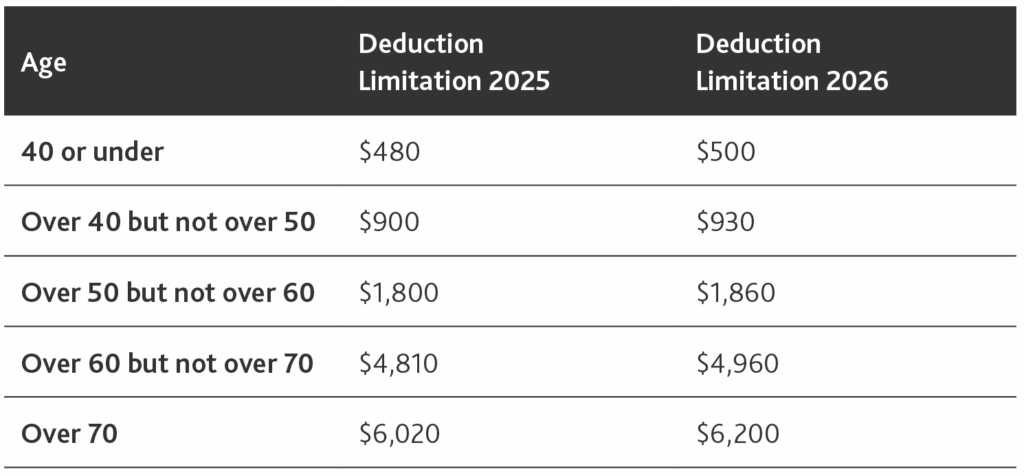
Retirement Plan Contributions
Individuals may wish to maximize their annual contributions to qualified retirement plans and individual retirement accounts (IRAs).
- The maximum amount in elective contributions that an employee can make in 2025 to a 401(k) or 403(b) plan is $23,500 ($31,000 if age 50 or over and the plan allows “catch-up” contributions). For 2026, these limits are $24,500 and $32,500, respectively.
- Effective January 1, 2025, the catch-up contribution was increased for plan participants who reached age 60, 61, 62, or 63 during the year. The catch-up contribution limit is the greater of $10,000 or 150% of the general catch-up limit in effect for 2024. For 2025, the super catch-up contributions limit for participants aged 60 through 63 is $11,250 ($7,500 multiplied by 1.5). In 2026, the increased catch-up limit remains at $11,250, indexed for inflation.
- The SECURE Act permits a penalty-free withdrawal of up to $5,000 from traditional IRAs and qualified retirement plans for qualifying expenses related to the birth or adoption of a child after December 31, 2019. The $5,000 distribution limit is per individual, so a married couple could receive a total of $10,000.
- Under the SECURE Act, individuals are now able to contribute to their traditional IRAs in or after the year in which they turn 70 1/2.
- Beginning in 2023, the SECURE Act 2.0 raised the age at which a taxpayer must start taking required minimum distributions (RMDs) to 73. If the individual reaches age 72 in 2024, the required beginning date for the first 2025 RMD is April 1, 2026.
- Individuals age 70 1/2 or older can donate up to $108,000 in 2025 ($111,000 in 2026) to a qualified charity directly from a taxable IRA.
- The SECURE Act generally requires that designated beneficiaries of persons who died after December 31, 2019, take inherited plan benefits over 10 years. Eligible designated beneficiaries (i.e., surviving spouses, minor children of the plan participant, disabled and chronically ill beneficiaries, and beneficiaries who are less than 10 years younger than the plan participant) are not limited to the 10-year payout rule. Special rules apply to certain trusts.
- Under final Treasury regulations (issued July 2024) that address RMDs from inherited retirement plans of persons who died after December 31, 2019, and after their required beginning date, designated and non-designated beneficiaries will be required to take annual distributions, whether subject to the 10-year rule or otherwise.
- Small businesses can contribute the lesser of (i) 25% of employees’ salaries or (ii) an annual maximum amount set by the IRS each year to a simplified employee pension (SEP) plan by the extended due date of the employer’s federal income tax return for the year when the contribution is made. The maximum SEP contribution for 2025 is $70,000. The maximum SEP contribution for 2026 is $72,000. The calculation of the 25% limit for self-employed individuals is based on net self-employment income, which is determined after reductions for the SEP contribution (as well as other deductions, such as self-employment taxes).
Foreign Earned Income Exclusion
The foreign earned income exclusion is $130,000 in 2025 and increases to $132,900 in 2026.
Alternative Minimum Tax
A taxpayer must pay either the regular income tax or the alternative minimum tax (AMT), whichever is higher. The established AMT exemption amounts for 2025 are $88,100 for unmarried individuals and individuals claiming head-of-household status, $137,000 for married individuals filing jointly and surviving spouses, $68,500 for married individuals filing separately, and $30,700 for estates and trusts. The AMT exemption amounts for 2026 are $90,100 for unmarried individuals and individuals claiming head-of-household status, $140,200 for married individuals filing jointly and surviving spouses, $70,100 for married individuals filing separately, and $31,400 for estates and trusts.
Kiddie Tax
A child’s unearned income is taxed at the parents’ tax rate if that rate is higher than the child’s tax rate.
Limitation on Deductions of State and Local Taxes (SALT Limitation)
For individual taxpayers who itemize their deductions, the OBBBA increased the SALT cap to $40,000 for 2025, with a phase-down to $10,000 for taxpayers with more than $500,000 in income. The $40,000 amount increases 1% per year from 2026 to 2029. The SALT cap sunsets to $10,000 in 2030. Notably, the pass-through entity deduction for SALT was retained, depending on client business and state. Various states have enacted new rules that allow owners of pass-through entities to avoid the SALT deduction limitation in certain cases.
Estate and Gift Taxes
For gifts made in 2025, the gift tax annual exclusion is $19,000 and for 2026 it is $19,000. For 2025, the unified estate and gift tax exemption and generation-skipping transfer tax exemption is $13.99 million per person. For 2026, the unified estate and gift tax exemption and generation-skipping transfer tax exemption is $15 million. All outright gifts to a spouse who is a U.S. citizen are free of federal gift tax. However, for 2025 and 2026, only the first $190,000 and $194,000, respectively, of gifts to a non-U.S. citizen spouse are excluded from the total amount of taxable gifts for the year.
Tax planning strategies may include:
- Making annual exclusion gifts.
- Making larger gifts to the next generation, either outright or in trust.
- Creating a spousal lifetime access trust (SLAT) or a grantor retained annuity trust (GRAT), or selling assets to an intentionally defective grantor trust (IDGT).
Charitable Contributions
Cash contributions made to qualifying charitable organizations, including donor-advised funds, in 2025 and 2026 will be subject to a 60% AGI limitation. The limitation on cash contributions to non-operating private foundations remains 30% of AGI.
The OBBBA created a new 0.5% AGI floor before individual charitable contributions will be deductible. The OBBBA also introduced a new 35% maximum benefit for itemized deductions.
Tax planning around charitable contributions may include:
- Creating and funding a private foundation, donor-advised fund, or charitable remainder trust.
- Donating appreciated property to a qualified charity to avoid long-term capital gains tax.
Additional Tax Provisions Introduced by OBBBA
The OBBBA introduced the following additional tax provisions to consider when tax planning:
- No tax on tips – Eligible tipped workers will be able to deduct up to $25,000 of their annual tip income from their federal taxable income for years 2025 through 2028.
- No tax on overtime – Federal income tax deduction for the “half” portion of “time-and-a-half” overtime pay, up to a maximum of $12,500 annually for individuals ($25,000 for joint filers), with the benefit phasing out for higher earners.
- Senior deduction – Individuals aged 65 and older can claim a temporary deduction up to $6,000 ($12,000 for married couples if both qualify). The deduction is available for itemizers and those taking the standard deduction, with the benefit phasing out for higher-income earners.
- Section 529 Plans – Offer greater flexibility, including an increased annual withdrawal limit for K-12 expenses from $10,000 to $20,000 per student starting in 2026; an expanded list of qualified K-12 costs to cover items like books, tutoring, and standardized test fees; and eligibility for expenses related to workforce training, licensing, and certification programs.
- Deduction on car loan interest – For tax years 2025 through 2028, taxpayers can deduct up to $10,000 annually for interest paid on a loan for a new, personal-use vehicle that was assembled in the U.S., with the deduction phasing out for higher incomes.
Net Operating Losses and Excess Business Loss Limitation
Net operating losses (NOLs) generated in 2025 are limited to 80% of taxable income and are not permitted to be carried back. Any unused NOLs are carried forward subject to the 80% of taxable income limitation in carry-forward years.
A noncorporate taxpayer may deduct net business losses of up to $313,000 ($626,000 for joint filers) in 2025. The limitation is $256,000 ($512,000 for joint filers) for 2026. A disallowed excess business loss (EBL) is treated as an NOL carryforward in the subsequent year, subject to the NOL rules. With the passage of the OBBBA, the EBL limitation has been made permanent.